Guide · Cooktop
Wolf burner clicks and clicks but will not light: what it is telling you
Written by
Noor Haddad
Cooking-appliance technician — induction and electric · 8 years in the trade
A Wolf burner that ticks on and on without ever catching is among the calls this route sees most, and among the ones read wrong most often. The clicking sounds like a fault in itself, so people replace knobs, clean the cooktop within an inch of its life, and eventually assume the whole maintop is finished. It almost never is. The clicking is the ignition system doing exactly what it was built to do, and the fault sits somewhere quite specific.
What the ticking actually is
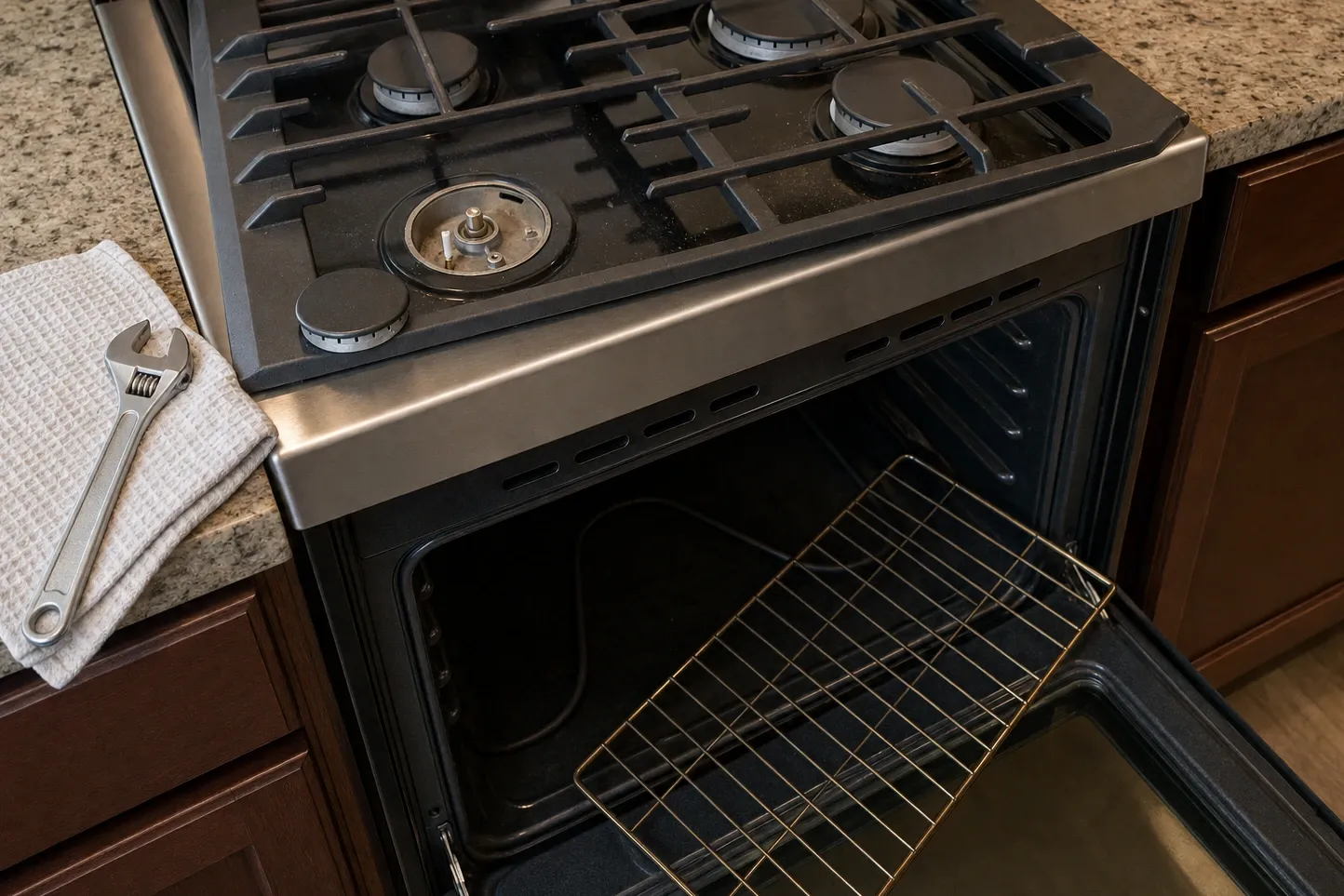
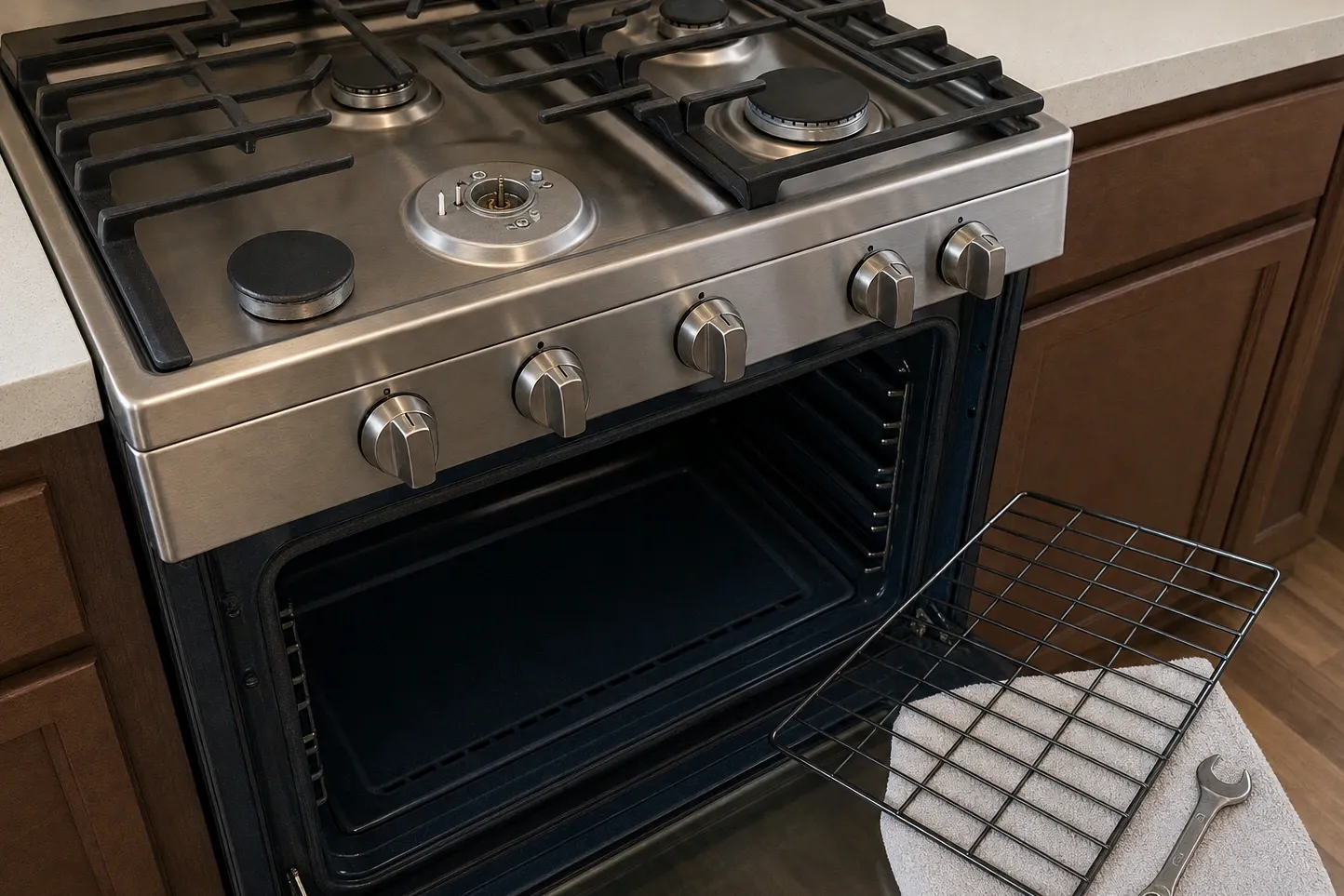
A spark electrode sits tucked beside every sealed burner on a Wolf cooktop, rangetop or range — a small ceramic post with a metal tip. Turn a knob past the ignition detent and a spark module starts firing a high-voltage pulse at that tip several times a second. That is the click. The spark jumps from the tip to the nearest earthed metal, which is the burner cap or the burner head itself, and if there is gas in that gap it lights.
Two facts follow from this, and they explain most of what you are hearing.
The first is that on most of this equipment one module fires every electrode at once. That is why lighting the front left burner sets the whole cooktop ticking. It is normal, and it should stop within a couple of seconds of a flame appearing.
The second is that the spark only crosses a gap of a couple of millimetres. It is not searching the whole burner ring for gas. It needs gas at that one point, in a gap of the right size, with clean metal on both sides. Take away any one of those three and you get a perfect, healthy, entirely useless click.
The three faults behind almost every one of these
Over four neighbourhoods and a lot of these calls, three causes account for the overwhelming majority.
A wet or contaminated electrode. A boil-over runs down into the burner well and sits there. Sugar and starch bake onto the ceramic; the spark then tracks across the residue instead of jumping the gap. This is the one that mysteriously fixes itself overnight and comes back the next time somebody boils pasta. Wolf’s burner wells are shallow on purpose, so this happens more than you would expect.
A cracked or eroded electrode. The ceramic post takes a knock from a heavy pan and hairline-cracks, or the tip corrodes away and widens the gap past what the module can jump. In Mar Vista, where marine air reaches the kitchen, we see this far more often than in Encino — salt attacks the tip and the earth strap together. The give-away is a spark that looks weak or yellow rather than a sharp blue snap, or sparking that wanders to the wrong place.
A blocked ignition port. Each burner ring has dozens of small ports. If the one sitting nearest the electrode is sealed with carbon or spilled food, gas comes out everywhere else and nowhere useful. The burner will often light from a match while still refusing to light from its own spark, which confuses everybody and is actually the clearest diagnostic clue in the whole list.
Two rarer causes are worth naming so you can rule them in or out. A failed spark module clicks on no burner at all rather than on all of them, so silence is the symptom, not noise. And a knob switch stuck closed by an old spill keeps the module energised permanently, which is what people mean when they say the clicking never stops.
What you can check yourself in five minutes
None of this needs tools, and all of it is safe with the gas off.
Turn the burner off and let the gas clear. Lift the cap and the burner head straight up — on Wolf sealed burners these lift out without fasteners — and look at the electrode beside the well. You are looking for three things: is it wet or coated, is the ceramic chipped or cracked, and is the metal tip still a tip rather than a stub.
While the head is off, hold it up to the light and look along the ring of ports, especially the one that faces the electrode. Carbon in a port shows as a dark plug. A soft brass brush and a wooden toothpick will clear it. Never a sewing needle or a drill bit — opening a port even slightly changes the flame at that spot for good.
Dry everything properly. A damp electrode after cleaning behaves exactly like a dirty one, which is why so many people conclude the cleaning made it worse. Put the head back squarely — a burner head sitting proud by a millimetre moves the earth point away from the electrode and kills the spark just as effectively as corrosion.
Then compare. Try a burner you know works and listen to it. A healthy ignition is a sharp, dry, insistent snap. A sick one sounds soft or hollow, or the interval is uneven.
What we do that you cannot
If it still will not light, the next steps are behind the maintop, and they need the equipment isolated.
We lift the maintop and check the spark module’s output and its earth, because a module firing at low voltage produces a click you can hear and a spark that cannot bridge a worn gap. We test each knob switch for continuity in both positions, which is what finds the one stuck closed. We check gas pressure at the manifold with a manometer — a regulator drifting low will light some burners and not others, and no amount of electrode cleaning will touch it. And we look at the orifice fitted to the burner, because a cooktop converted for propane and then run on natural gas, or the reverse, produces exactly this complaint along with an orange, sooty flame.
Under the maintop is also where the water goes. Years of boil-overs collect in the tray, and a module sitting in that is the fault behind a good number of these calls.
When it is worth calling
Call if any of the following is true.
The clicking never stops, even with every knob off. That is an energised module and it should not be left that way.
More than one burner is affected, or the ignition works on the small burners and not the large one. That pattern points at pressure or at the module, not at a single electrode.
You can smell gas at any point, or the burner lights with a thump rather than a whisper. Stop there and stop using it.
The electrode looks perfect, the port is clear and it still will not catch. At that point you have done everything that can be done from the top, and the answer is underneath.
And if the flame does light but burns tall, orange and leaves soot on your pans, that is a different fault with the same origin — the burner or the orifice — and it is worth booking rather than living with. Soot on a copper pan is unburnt fuel, and unburnt fuel in a kitchen is not a cosmetic problem.
One last thing to say plainly. Ignition that fails again a few months after it was put right on an older gas cooktop has stopped being a story about one part, and the question becomes whether the deck itself is still worth buying parts for.
Common follow-ups
Is it safe to keep trying the burner while it clicks?
Once or twice, no longer. Every attempt puts unburnt gas into the room, and a burner that lights late can light with a thump instead of a whisper. Turn the knob off, give it a minute for the gas to clear, and try one more time. If it still will not catch, leave that burner alone and use another one.
Why do the other burners keep clicking once one is lit?
On most Wolf cooktops and rangetops one spark module feeds every electrode, so it fires all of them together and stops when the flame sensing circuit reports a flame. Clicking that carries on after everything is lit means the module is not being told to stop, which is usually a knob switch stuck closed or a wet electrode shorting to the burner cap.
Can a blocked port really stop a burner lighting altogether?
Yes, if it is the port nearest the electrode. The spark only crosses a few millimetres, so it needs gas at that exact spot. A burner with the rest of its ring perfectly clear will still refuse to catch if a boil-over has sealed the one port doing the work.
Does marine air near Mar Vista really shorten igniter life?
In our experience on this route, clearly. Salt air corrodes the electrode tip and the earth strap it sparks against, and once the gap widens or the ceramic cracks the spark goes weak or wanders. Kitchens a few miles from the water go through electrodes noticeably faster than the same equipment in Encino.